Project operation cooperation
Industry News
Understanding HJ 945.4—2026: A Comprehensive Breakdown of New Trends in Industrial Park Wastewater Standard-Setting
 2026-07-17






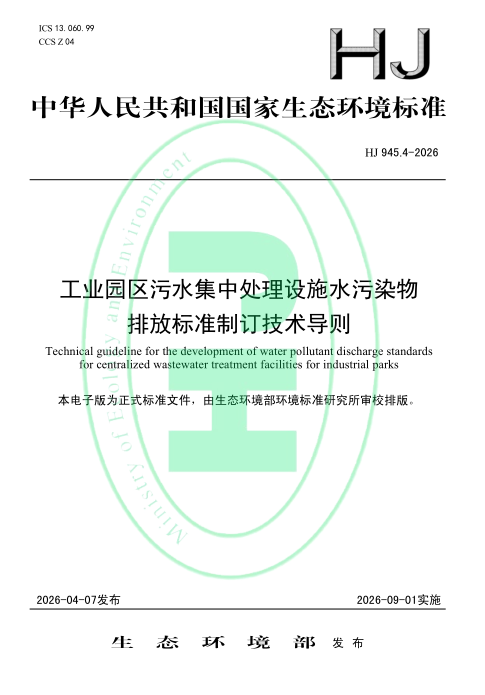
01 / Breaking Down the Guidelines:
Four Core Trends in Future Standard Formulation and Revision
Based on readings by industry experts and our own practical observations, the Guidelines have charted four clear paths for the "tailor-made" future discharge standards of various parks:
1.More refined park classification:
Industry-differentiated parks prioritize "one park, one policy."
The Guidelines divide industrial parks into two major categories: single-industry type and comprehensive type. Among them, comprehensive parks are further subdivided into: similar-industry type, industry-dominant type, and industry-differentiated type.
The "70/30 Rule" takes effect: Parks where enterprises subject to the same discharge standard account for 70% or more of the park's total wastewater discharge are classified as industry-dominant type.
Priority for one park, one policy: For "industry-differentiated comprehensive parks" with mixed industry types and where the proportion of water subject to the same standard is below 70%, differentiated management requirements under "one park, one policy" will be prioritized in future standard formulation and revision.
2. Park wastewater plants play a "safety net" role:
Full coverage of basic items.
The Guidelines clearly stipulate that discharge standards for comprehensive parks should adopt all pollutant items from the water pollutant discharge standards implemented by enterprises within the park as the basic control items for the park's centralized treatment facilities. This means centralized wastewater plants must fulfill a "safety net" function, comprehensively preventing and controlling potential gaps in characteristic pollutant assessment between upstream and downstream.
3. Three major control indicators step into the spotlight:
Comprehensive toxicity, salinity, and PFOA.
Regarding the ecological risks posed by specific industrial wastewater, the Guidelines highlight three hard constraints:
Comprehensive toxicity (comprehensive risk control): For parks in high-toxicity-risk industries such as metal smelting, electroplating, printing and dyeing, pesticides, and pharmaceuticals, comprehensive toxicity control items should be established when effluent is directly discharged. The industry currently focuses on acute toxicity, with future gradual extension toward chronic toxicity and other directions.
Salinity (high-salinity wastewater regulation): For industrial parks with high-salinity wastewater, control items for salinity (total salt content, etc.) need to be established.
Perfluorooctanoic acid (PFOA) (synergistic control of emerging pollutants): For parks in industries that produce or use per- and polyfluoroalkyl substances (PFAS), particularly PFOA-related industries (such as petrochemicals and synthetic resins), PFOA will be formally incorporated into standard control.
4. Encouraging reclaimed water recycling:
Clear linkage mechanisms.
Considering that industrial parks are major water users and dischargers, the Guidelines specifically propose linkage-related provisions in standard formulation, encouraging park effluent to be used for landscaping, urban miscellaneous uses, and other resource utilization scenarios. This points the way for the transformation of park water ecology from "single discharge" to "closed-loop reuse."
02 / Industry Reflection:
Although Not Directly Enterprise-Facing, the Winds Have Shifted
Although the Guidelines govern the rules for standard formulation and revision and do not immediately change existing discharge permit limits, the signals they release have far-reaching implications:
For park managers: Future water pollutant management will bid farewell to the extensive "one-size-fits-all" approach of referencing urban standards. How to precisely identify characteristic pollutants? How to scientifically conduct toxicity assessments and receiving water body risk demonstrations? This places extremely high demands on park governance capacity and preliminary research.
For upstream discharging enterprises: As future park-specific standards are gradually established, source clean production and upgrading of pretreatment facilities (such as pretreatment targeting specific indicators like PFOA, comprehensive toxicity, and high salinity) will become an inevitable trend.
03 / TongYong Environmental Protection Group:
Reading the Winds, Technology and Equipment Already in Place
As a veteran environmental protection enterprise in Jiangsu Yixing—the "Hometown of Environmental Protection"—Tongyong Environmental Protection Group has always closely followed the iteration of national water environment policies. The future park water governance blueprint depicted in the Guidelines happens to align highly with the high-tech capabilities we have quietly built over the years:
Facing "one park, one policy" and characteristic pollutant source tracing: We hold multiple qualifications including Grade I Professional Contracting for Environmental Protection Engineering and Grade B Design for Environmental Engineering Special Projects. We have undertaken numerous municipal and highly challenging industrial wastewater projects, allowing us to accumulate solid foundational wastewater treatment experience and water quality analysis data. Even if local governments initiate differentiated standard-setting in the future, we are fully capable of assisting local authorities and parks with drainage surveys and diagnostics.
Facing high-difficulty indicators such as "comprehensive toxicity" and "PFOA": Tongyong Environmental Protection Group has built an integrated full-chain solution from customized processes to intelligent equipment. For persistent organic pollutants (such as PFOA and other emerging pollutants) and toxicity reduction, we have already reserved mature unit-level integrated equipment including advanced oxidation and membrane separation, capable of efficiently assisting enterprises and parks with targeted pretreatment upgrades.
Facing "resource utilization" standard linkage: Tongyong Environmental Protection Group not only excels in general engineering contracting but also possesses extensive experience in water project investment and operation. In reclaimed water reuse and high-standard recycled water circulation system construction, our mature processes can perfectly align with the Guidelines' green advocacy for efficient park water resource reuse.
Conclusion
The issuance of the Guidelines is conducive to accelerating the filling of standard gaps in industrial parks and enhancing park environmental governance efficiency—a long-term national strategic layout for promoting high-quality development.
In the future, Tongyong Environmental Protection Group will continue to take root in the fertile soil of environmental protection, elevate water treatment technology, and with a more forward-looking vision and more solid actions, help every park achieve a leapfrog upgrade from "compliance discharge" to "ecological circulation."
供 稿 | 技术部
编 辑 | 沈昕怡 季长宝
审 核 | 张铭尹
Related recommendations

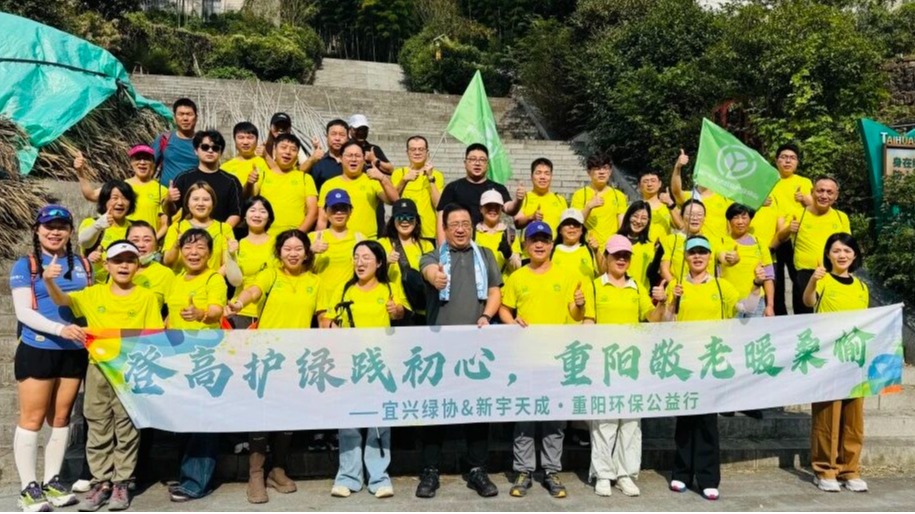
Public Welfare | "Xinyu Tiancheng · Climbing High …
-
2026-10-19
Public Welfare | "Xinyu Tiancheng · Climbing High and Looking Afar to Warm Double Ninth" Public Welfare Environmental Protection Walk
-
2026-09-10
Journey of Wisdom | Visiting Sujing Group and Huashijie (Suzhou) Intelligent Manufacturing Base
-
2026-09-04
Before the Wind Rises, See the Road Clearly | "Green Association Second Generation Growth Camp" Third Lecture
-
2026-08-19
WorkBuddy Empowers Administrative Office and Application Practice Special Training Successfully Held
-
2026-07-30
[Compliance-Driven Voyage · Wuxi's Aspiration to Go Global] Wuxi Enterprises' High-Quality Globalization International Exchange and Matchmaking Training Conference Successfully Held at Tongyong Environmental Protection Group